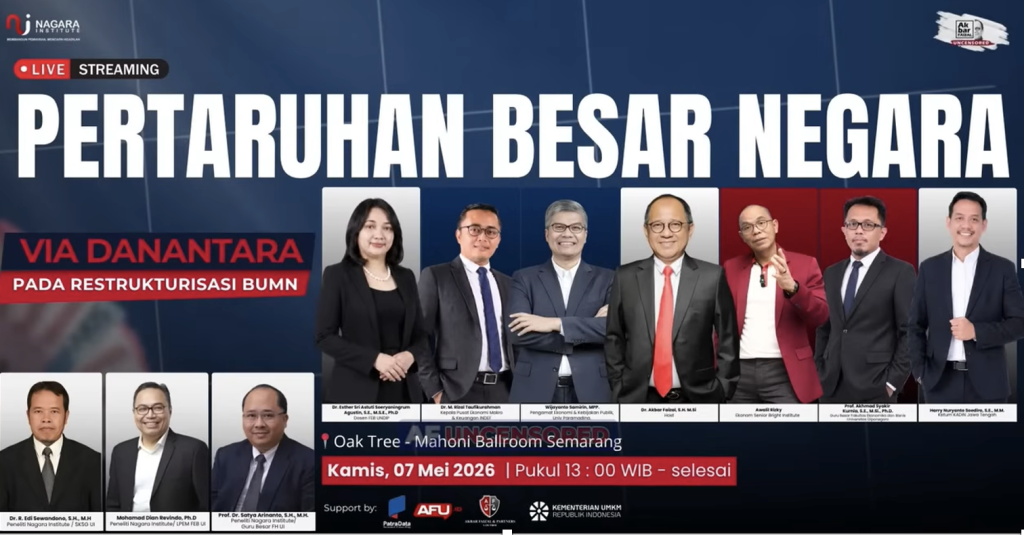
In the ROUND TABLE DISCUSSION: The State’s Big Bet via Danantara on SOE Restructuring, a number of academics and national economists highlighted the major challenges faced by the government in encouraging SOE restructuring through the establishment of Danantara as the state’s strategic superholding.
Prof. Akhmad Syakir Kurnia emphasized that the formation of Danantara needs to be understood in the context of Indonesia’s political economy which has different characteristics compared to countries such as Singapore, Norway, and China which are known to have strong fiscal discipline and institutional governance.
According to him, Indonesia’s current fiscal condition faces a relatively narrow fiscal space, while the transfer of SOE dividends to Danantara has the potential to reduce the direct contribution to state budget revenue. Therefore, he considered that this step is a big gamble for the state that needs to be accompanied by strengthening governance, transparency, and public supervision.

Prof. Syakir also highlighted the potential risk of political intervention and the limitations of public control mechanisms if Danantara’s accountability is only directly under the President. According to him, strengthening the checks and balances system is an important aspect so that the management of the state’s strategic assets continues to run professionally and accountably. Meanwhile, Esther Sri Astuti Soeryaningrum Agustin said that the transformation of Danantara as a state-owned superholding is a big step with a high level of risk so that it requires professional, transparent, and meritocracy-based management.
She emphasized that political intervention in the management of Danantara must be minimized so that business and investment decisions can run objectively and are oriented towards long-term economic sustainability. In addition, the placement of quality human resources in strategic positions is considered to be a key factor in determining the success of the institutional transformation. According to Esther, Indonesia’s current political economy institutions have not fully supported the implementation of a superholding model such as Danantara if it is not accompanied by strong governance reforms. Therefore, public participation and external control are considered very important to maintain accountability and prevent potential irregularities in the management of state assets.

He added that the discussion was part of a series of academic and policy studies whose results would be submitted to the President as a consideration in the formulation of national policies related to the restructuring of SOEs and strengthening state investment. This discussion presented various economists, academics, and stakeholders to discuss the economic, fiscal, and governance implications of Danantara on the future direction of development and management of Indonesian SOEs.
Youtube Link: