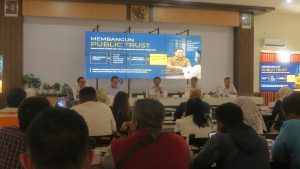
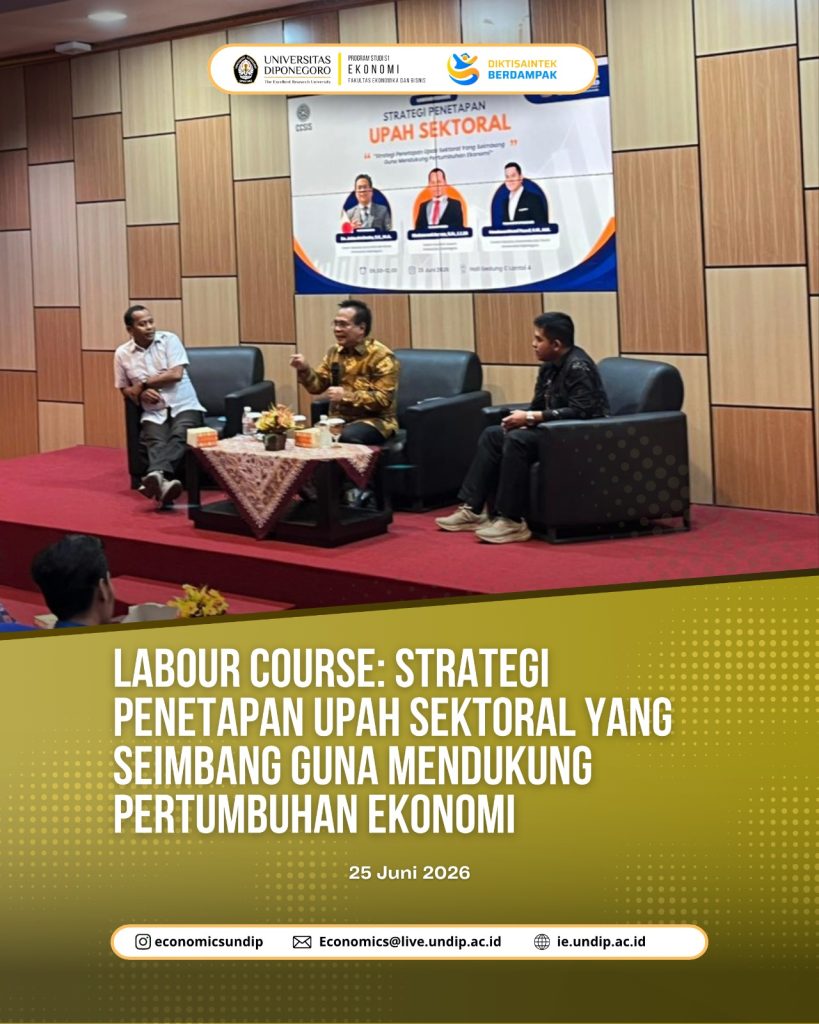
Semarang, June 25, 2026 – The Faculty of Economics and Business, Diponegoro University (FEB UNDIP) in collaboration with the Central Java Labor Alliance (ABJT) held a Labor Course entitled “Strategies for Setting Balanced Sectoral Wages to Support Economic Growth” at Hall of Building C, 4th Floor, FEB UNDIP. This activity was attended by more than 100 participants from various regions in Central Java and represented various trade union federations and various business sectors, including the metal, chemical, energy, mining, oil and gas, pharmaceutical, health, cement, manufacturing, and other strategic sectors. The enthusiasm of the participants showed the high attention to the issue of sectoral wages as one of the important instruments in creating harmonious and equitable industrial relations.
The event presented Dr. Jaka Aminata, S.E., M.A. from the Faculty of Economics and Business, Diponegoro University as the main speaker who discussed sectoral wage determination strategies based on the perspective of economy, productivity, and industrial competitiveness. The material was then enriched by Muhamad Azhar, S.H., LL.M. from the Faculty of Law, Diponegoro University who reviewed the regulatory aspects and legal basis of sectoral wages in Indonesia. The discussion took place interactively by presenting Maulana Ghani Yusuf, S.Si., M.E. as a responder who provided a perspective on the importance of a balance between worker welfare, business sustainability, and regional economic growth.
During the discussion session, participants actively conveyed various experiences and challenges faced in each business sector. The diverse views of trade unions are valuable inputs in formulating wage policies that are more adaptive to the characteristics of each sector. In the response session, Maulana Ghani Yusuf emphasized that the improvement of workers’ welfare is not only determined by the magnitude of wage increases, but also by the ability of workers to create added value for the company. According to him, improving competencies through training, certification, mastery of technology, innovation, and increasing productivity are important factors so that workers have higher competitiveness so that an increase in income can occur sustainably. Thus, sectoral wage policies need to be accompanied by investment in the development of the quality of human resources in order to provide optimal benefits for workers and the business world.
Through this activity, FEB Diponegoro University together with the Central Java Labor Alliance hopes to create a constructive dialogue space between academics, trade unions, the business world, and stakeholders in building a fairer, more sustainable, and progress-oriented wage policy. “The welfare of workers and the progress of the business world are not two conflicting goals. With science, competency improvement, and the spirit of collaboration, every worker can create greater added value, so that welfare increases along with the growth of productivity and the nation’s economy.”